Evolutionary Optimization Reveals Structural Constraints on Reservoir Architecture for Spatiotemporal Chaos
Summary
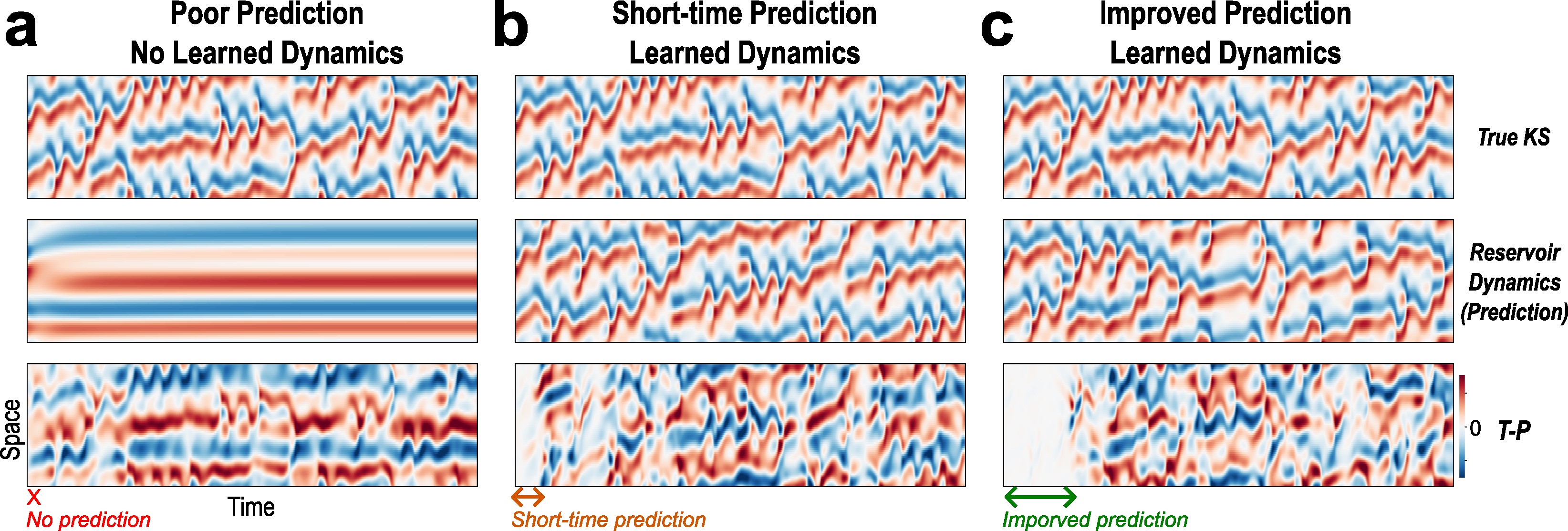
This work asks how recurrent dynamical substrates change when they are placed under evolutionary selection for prediction, using reservoir computers trained to forecast Kuramoto--Sivashinsky spatiotemporal chaos. Rather than simply improving error by making reservoirs larger or denser, evolution exposes structural constraints: a diminishing-return size--efficiency frontier, conserved spectral organization, refined low-eigenvalue slow modes, intermediate modularity, and pruning of connection cost. The result frames evolutionary reservoir computing as a bio-inspired and mechanistic probe of adaptive prediction, linking physics, machine learning, neuroscience, and biological computation.
Links
BibTeX tap to expand
@article{Dehghani2026resevomech,
      title={Evolutionary Optimization Reveals Structural Constraints on Reservoir Architecture for Spatiotemporal Chaos},
      author={Nima Dehghani},
      year={2026},
      eprint={2606.22765},
      archivePrefix={arXiv},
      primaryClass={cs.NE},
      url={https://arxiv.org/abs/2606.22765},
}
Code & Data
The room
Abstract
Biological systems maintain function in fluctuating environments by transforming past stimulation into internal dynamical states that support future-oriented responses. Reservoir computing provides a computational analogue, but the standard framework usually treats the recurrent substrate as a fixed random network and trains only the readout. Here we ask how the recurrent substrate itself changes when reservoir architecture is placed under evolutionary selection for prediction. Using the Kuramoto–Sivashinsky equation as a testbed for spatiotemporal chaos, we evolved reservoirs over five construction hyperparameters: size, connectivity degree, spectral radius, input scaling, and readout regularization. Evolutionary optimization reduced prediction error at the population level, extended the low-error forecast horizon, and organized the reservoir design space along a diminishing-return size–efficiency frontier. Structural analyses revealed that evolved reservoirs remained within a conserved stochastic-block-model-like spectral envelope while showing directional refinement of low-eigenvalue modes, locking of macroscopic modularity to a narrow intermediate band, and exponential pruning of connection cost within that band. Pareto analysis showed that elite predictive reservoirs occupied a horizontal floor in the cost–modularity plane, indicating that accuracy and structural efficiency were achieved jointly rather than through a simple trade-off. Together, these findings show that evolutionary optimization does not merely reduce prediction error, but exposes interpretable structural constraints on the recurrent substrate itself, stabilizing a task-suitable dynamical class and refining the architectural degrees of freedom most relevant for prediction. Evolutionary reservoir computing therefore provides a bio-inspired framework for studying how predictive demands shape adaptive dynamical networks across machine learning, complex systems, and biological computation.
Citing
If you use this code or build on these ideas, please cite the paper using the BibTeX entry above.
Doors · concepts in this room
Related rooms
Algebraic Emergence of Effective Theories in Canonical Recurrent Motifs of Biological Neuronal Networks
Autonomous Physical Computation: A Categorical Closure Criterion for Physical and Neuromorphic Reservoirs.