Harnessing cortical geometry, wiring, and function as inductive biases for recurrent neural networks
Summary
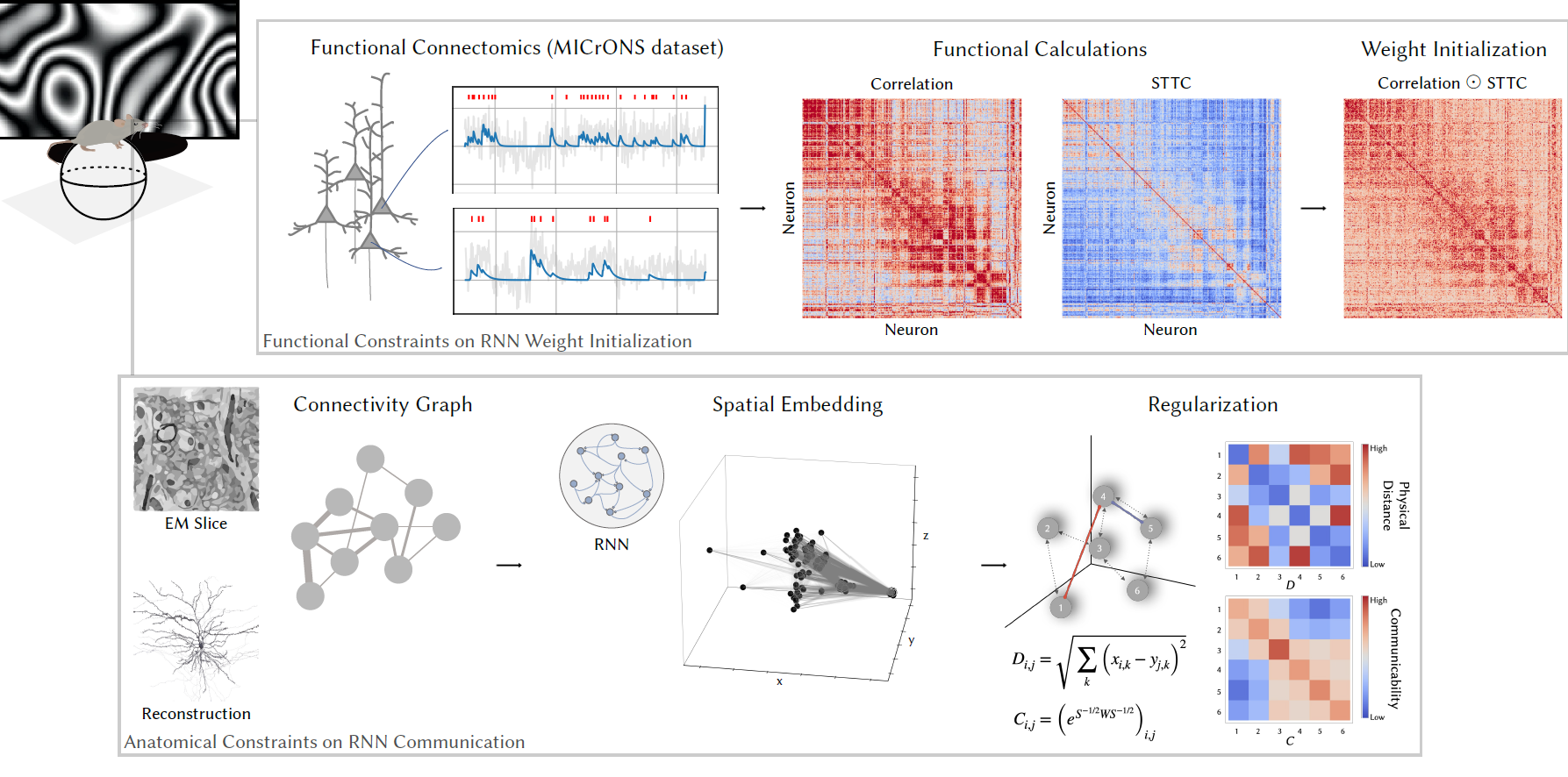
In this paper, we asked whether measured cortical organization can be used as an inductive bias for artificial recurrent neural networks. Using MICrONS functional connectomics data, the study grounds RNNs in cortical spatial geometry, anatomical wiring, and activity-derived functional relationships. We found that cortical priors improve recurrent learning, with function-derived weight initialization providing the strongest benefit, real spatial embedding adding a robust secondary gain, and communicability shaping learned topology more selectively. Beyond task performance, the biologically constrained networks converge toward more structured, low-entropy, modular, and small-world regimes, suggesting that cortical organization is not merely biological detail but computational structure. This approach provides a blueprint for creating constrained RNNs that beat vanilla RNNs.
Links
BibTeX tap to expand
@ARTICLE{DehghaniAvalanche_2012,
AUTHOR={Dehghani, Nima  and Hatsopoulos, Nicholas G. and Haga, Zach D. and Parker, Rebecca  and Greger, Bradley  and Halgren, Eric  and Cash, Sydney S. and Destexhe, Alain},
TITLE={Avalanche Analysis from Multielectrode Ensemble Recordings in Cat, Monkey, and Human Cerebral Cortex during Wakefulness and Sleep},
JOURNAL={Frontiers in Physiology},
VOLUME={Volume 3 - 2012},
YEAR={2012},
URL={https://www.frontiersin.org/journals/physiology/articles/10.3389/fphys.2012.00302},
DOI={10.3389/fphys.2012.00302},
ISSN={1664-042X},
}
Code & Data
The room
Abstract
How the wiring and functional organization of cortex shape recurrent computation remains a central question in both neuroscience and machine learning. Here, we leverage data released through the Machine Intelligence from Cortical Networks (MICrONS) program–a functional connectomics resource spanning multiple areas of mouse visual cortex, in which dense calcium imaging is co-registered with high-resolution electron microscopy reconstruction from the same animal–to build biologically grounded recurrent neural networks. Using neuronal spatial coordinates, anatomical connectivity, and function-derived relationships from nearly 12,000 coregistered excitatory neurons, we initialize recurrent weights and impose communication-aware spatial constraints during learning. Across three cognitive decision-making tasks, networks constrained by cortical structure and function consistently outperform baseline and partially constrained models. Functional weight initialization provides the largest gain, while real spatial embedding yields robust additional improvements across conditions. These biologically grounded networks also develop low-entropy, modular, and small-world organization, and retain strong performance even when recurrence is restricted to positive weights. Together, our results show that the machinery of cortex–its geometry, wiring, and functional structure–can be harnessed as a powerful inductive basis for building recurrent networks that learn more effectively while converging toward key organizational principles of biological computation.
Citing
If you use this code or build on these ideas, please cite the paper using the BibTeX entry above.
Doors · concepts in this room
Related rooms

Spatially Masked Regression Reveals Local and Distributed Predictability in Electrophysiological Recording
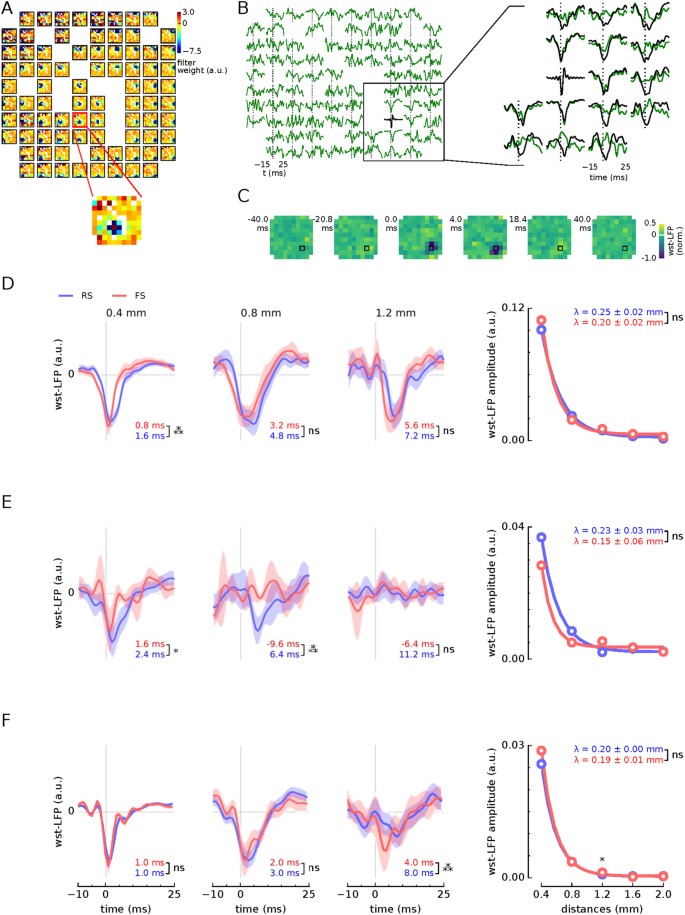
Local field potentials primarily reflect inhibitory neuron activity in human and monkey cortex