Open Data In Neurophysiology: Advancements, Solutions & Challenges
Summary
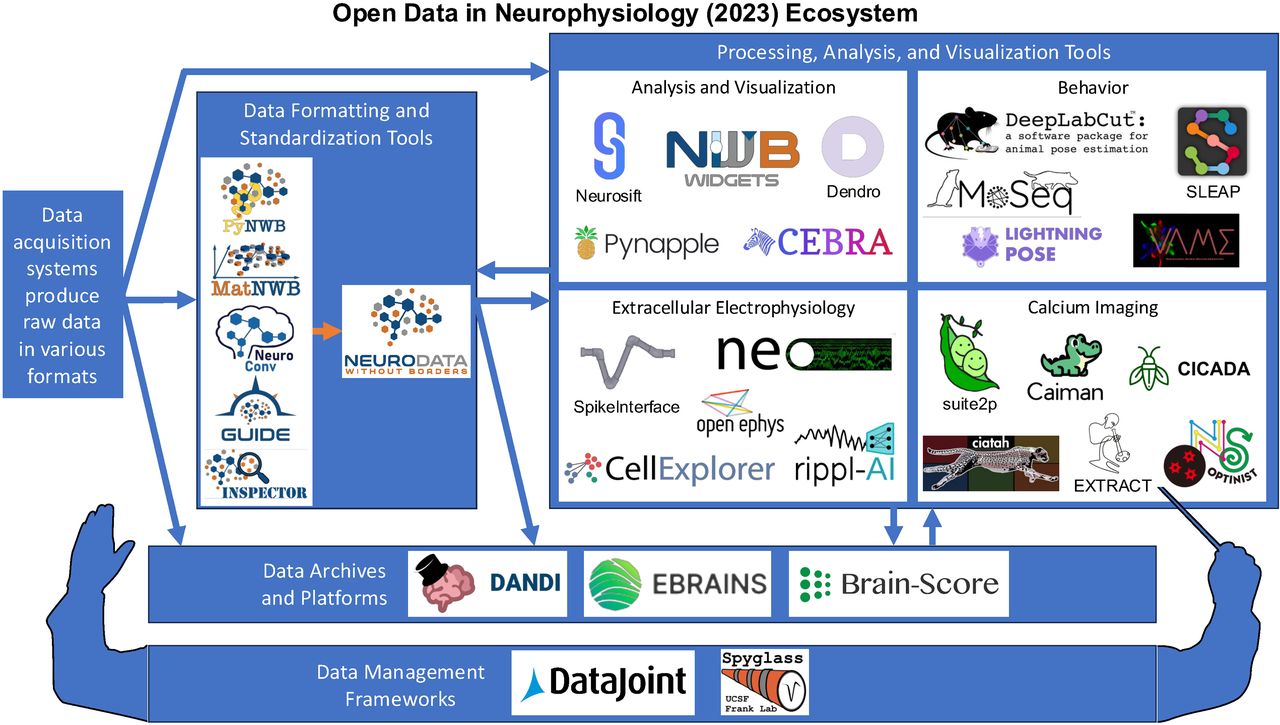
This paper outlines a comprehensive framework for advancing open science principles and data sharing practices across the neurophysiology community. Born out of the Open Data in Neuroscience (ODIN) symposium, the work reviews critical progress in standardized data formats like Neurodata Without Borders (NWB), unified metadata ontologies, and automated pipeline ecosystems. We address the balancing act between implementing rigorous data standard strictness and preserving the flexibility required by diverse experimental labs, arguing that fostering collaborative, open-access social and technical structures is vital for driving global, reproducible discovery.
Links
BibTeX tap to expand
@article{ColleenDehghani_ODIN_2025,
    author = {Gillon, Colleen J. and Baker, Cody and Ly, Ryan and Balzani, Edoardo and Brunton, Bingni W. and Schottdorf, Manuel and Ghosh, Satrajit and Dehghani, Nima},
    title = {Open Data In Neurophysiology: Advancements, Solutions \& Challenges},
    volume = {12},
    number = {11},
    elocation-id = {ENEURO.0486-24.2025},
    year = {2025},
    doi = {10.1523/ENEURO.0486-24.2025},
    publisher = {Society for Neuroscience},
    URL = {https://www.eneuro.org/content/12/11/ENEURO.0486-24.2025},
    eprint = {https://www.eneuro.org/content/12/11/ENEURO.0486-24.2025.full.pdf},
    journal = {eNeuro}
}
Code & Data
The room
Abstract
Ongoing efforts over the last 50 years have made data and methods more reproducible and transparent across the life sciences. This openness has led to transformative insights and vastly accelerated scientific progress (Gražulis et al., 2012; Munafó et al., 2017). For example, structural biology (Bruno and Groom, 2014) and genomics (Benson et al., 2013; Porter and Hajibabaei, 2018) have undertaken systematic collection and publication of protein sequences and structures over the past half century. These data, in turn, have led to scientific breakthroughs that were unthinkable when data collection first began (Jumper et al., 2021). We believe that neuroscience is poised to follow the same path, and that principles of open data and open science will transform our understanding of the nervous system in ways that are impossible to predict at the moment. New social structures supporting an active and open scientific community are essential (Saunders, 2022) to facilitate and expand the still limited adoption of open science practices in our field (Schottdorf et al., 2024). Unified by shared values of openness, we set out to organize a symposium for open data in neurophysiology (ODIN) to strengthen our community and facilitate transformative open neuroscience research at large. In this report, we synthesize insights from this first ODIN event. We also lay out plans for how to grow this movement, document emerging conversations, and propose a path toward a better and more transparent science of tomorrow.
Citing
If you use this code or build on these ideas, please cite the paper using the BibTeX entry above.
Doors · concepts in this room
Related rooms
How Long Is the Coast of a Neuron? Resolution-Dependent Interaction Order and Computational Capacity
Field closure, ice neurons, and when a dendrite is a motif