Field closure, ice neurons, and when a dendrite is a motif
Summary
This paper asks when a dendritic-looking structure becomes a genuine dynamical motif rather than simply the product of a growth instability. It introduces a continuum model in which “ice neurons” arise as the zero-field-closure limit, while finite coupling allows an internal excitable state to write into—and be acted on by—the surrounding field, producing enhanced persistence and a coupled Hopf regime. The results separate morphology, active cable dynamics, and field closure as distinct ingredients of neuronal computation.
Links
BibTeX tap to expand
@misc{dehghani2026iceneurons,
      title={Field closure, ice neurons, and when a dendrite is a motif},
      author={Nima Dehghani},
      year={2026},
      eprint={2610.00184},
      archivePrefix={arXiv},
      primaryClass={q-bio.NC},
      url={https://arxiv.org/abs/2610.00184},
}
Code & Data
The room
Abstract
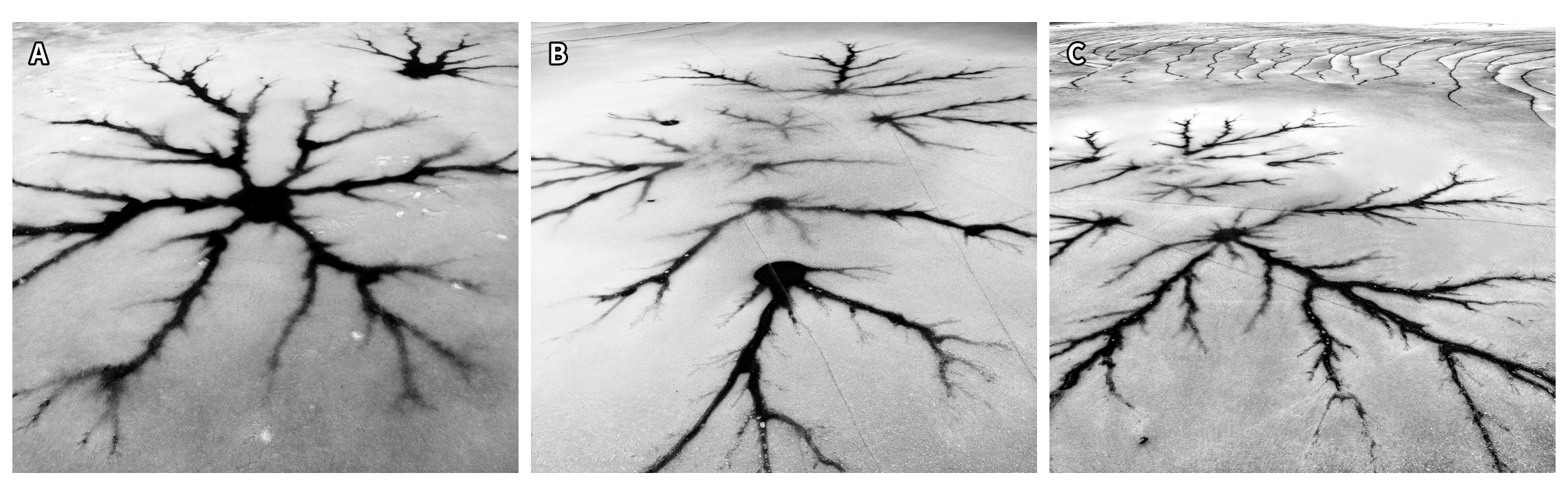
Dendritic silhouettes are cheap. Pond ice neurons, diffusion-limited aggregates, wiring-minimizing arbors, and biological neurons can share a branching statistic because they share a growth instability, not because they are functionally similar. We take that observation as a modeling constraint. The ice neuron only structurally resembles a biological neuron. A biological neuron carries an internal state and a field that it helps generate, letting geometry, dynamics, and field co-sculpt one another. In our construction, the ice neuron is the zero-gain limit of an interfacial system in which a FitzHugh–Nagumo state lives on the moving front and writes back into the field that drives it, with dimensionless gain γ. At γ=0, morphology and internal dynamics decouple into a Mullins–Sekerka growth band and a damped oscillator. Finite γ deforms the spectrum, shifts the selected instability, and opens an oscillatory region below the isolated Hopf threshold. On a dendrite grown at γ=0 and then frozen, field closure increases distal persistence without changing the geometry; its first-order effect remains positive across repeated realizations of the same growth rule and localizes to a small set of non-cable field shortcuts. Nonlinear dynamics remain finite beyond the linear instability: below threshold, closure is almost the transmission; at spike amplitude, it is a correction to a regenerative cable event. A dendritic tree therefore is not intrinsically a structural spandrel. Shape alone is morphology without an internal state or a source term. That is the dendritic silhouette of the ice neuron. Excitability adds an active cable. Field closure is the biophysical mélange in which the neuron helps write the field that acts back on it, sculpting its dynamics and, during growth, its structure. That is a biological neuron.
Citing
If you use this code or build on these ideas, please cite the paper using the BibTeX entry above.
Doors · concepts in this room
Related rooms
Algebraic Emergence of Effective Theories in Canonical Recurrent Motifs of Biological Neuronal Networks
Autonomous Physical Computation: A Categorical Closure Criterion for Physical and Neuromorphic Reservoirs.