Autonomous Physical Computation: A Categorical Closure Criterion for Physical and Neuromorphic Reservoirs.
Summary
Links
BibTeX tap to expand
@article{Dehghani2026resevomech,
      title={Evolutionary Optimization Reveals Structural Constraints on Reservoir Architecture for Spatiotemporal Chaos},
      author={Nima Dehghani},
      year={2026},
      eprint={2606.22765},
      archivePrefix={arXiv},
      primaryClass={cs.NE},
      url={https://arxiv.org/abs/2606.22765},
}
Code & Data
The room
Abstract Physical reservoirs, neuromorphic devices, and wave-mediated systems often possess memory, feedback, and rich state-dependent dynamics, but these properties do not by themselves establish autonomous computation. Here we develop a closure criterion for autonomous physical computation, motivated by the wave-particle walker. We formulate the walker as a stroboscopic reservoir whose physical state combines the droplet’s position, velocity, and bouncing phase with a wave-memory field that stores an exponentially decaying trace of previous droplet impacts and guides future motion through local slope coupling. This model separates physical writing, storage, reading, feedback, and externally triggered erasure. We then define computation as robust coarse-grained transition preservation: a physical map implements an abstract transition rule only when a coarse-graining from physical to abstract states commutes with the dynamics, with abstract states realized by separated physical basins and transitions stable under noise. Autonomous physical computation requires a further closure condition: an internal physical readout state must select the next physical operation, so that the operation applied at each step is a function of the system’s own readout rather than of an external schedule. This criterion classifies the wave-particle walker as a wave-memory machine with genuine Turing-like primitives, but not as a closed autonomous physical computer, because the erasing phase shift is externally imposed. The framework turns this distinction into a design principle: memory becomes autonomous computation when physical readout basins are coupled back to operation selection.
Citing
If you use this code or build on these ideas, please cite the paper using the BibTeX entry above.
Doors · concepts in this room
Related rooms
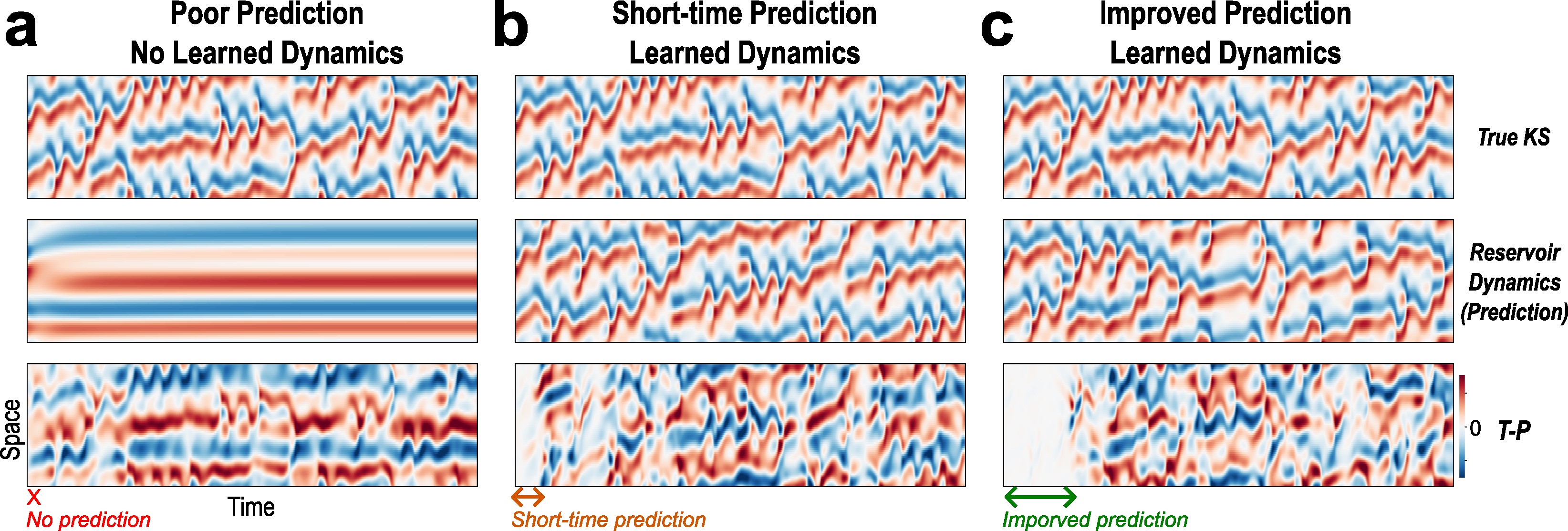
Evolutionary Optimization Reveals Structural Constraints on Reservoir Architecture for Spatiotemporal Chaos
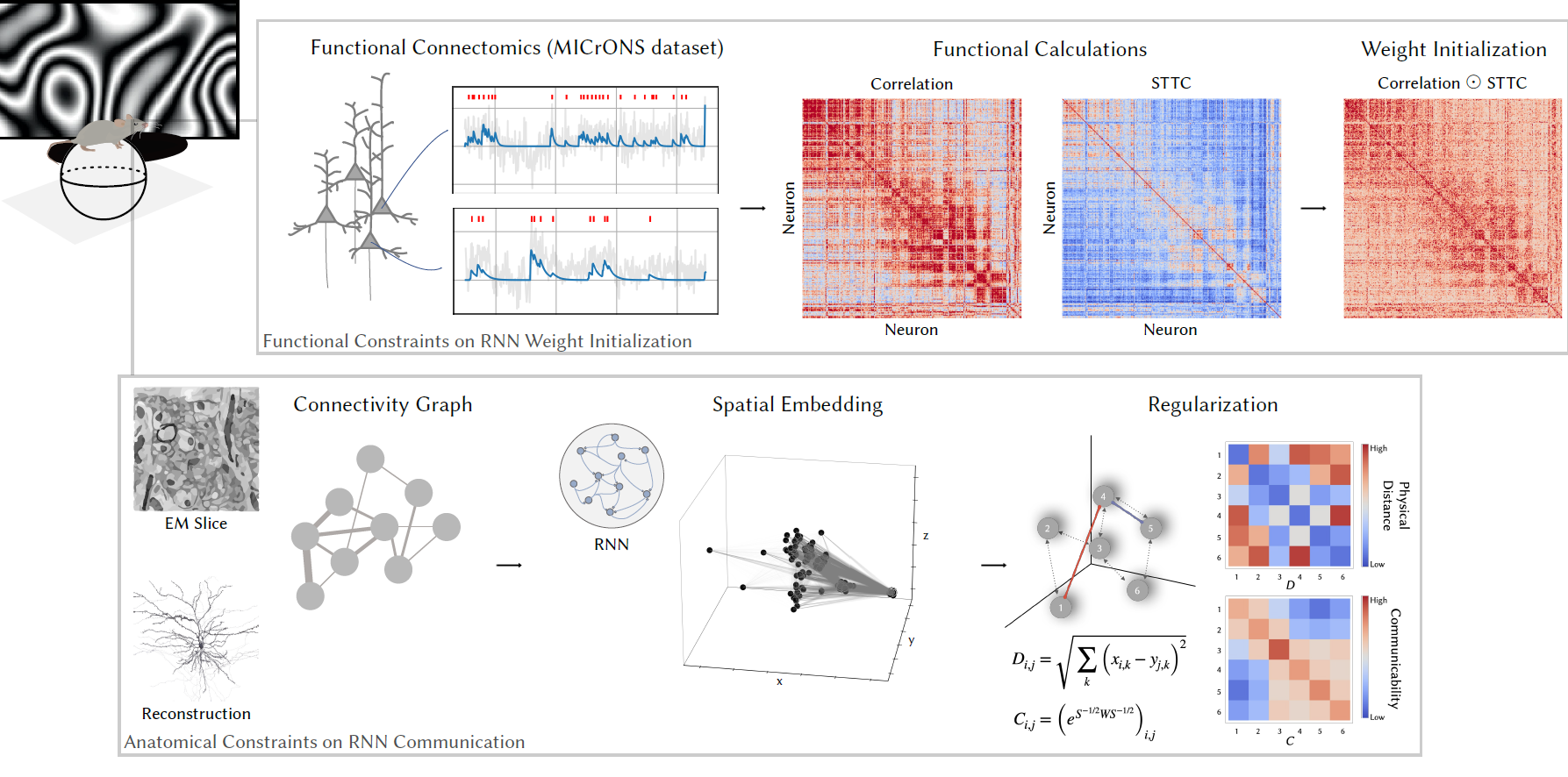
Harnessing cortical geometry, wiring, and function as inductive biases for recurrent neural networks