Avalanche Analysis from Multielectrode Ensemble Recordings in Cat, Monkey, and Human Cerebral Cortex during Wakefulness and Sleep
Summary
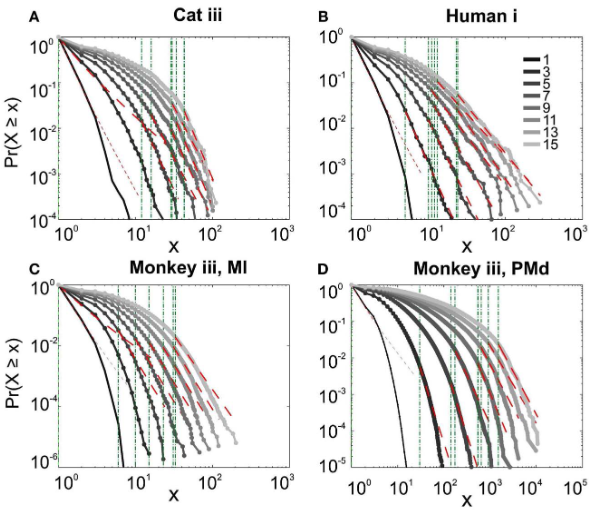
This paper examines the prominent hypothesis that the intact mammalian brain operates near a state of self-organized criticality. By analyzing high-density multielectrode array recordings of both single-unit spikes and local field potentials (LFPs) across cats, macaques, and humans during wakefulness, slow-wave sleep, and REM sleep, the study applies rigorous statistical criteria—such as cumulative distribution functions (CDFs)—to assess the presence of scale-free neuronal avalanches. The findings reveal that apparent power-law distributions in LFP peaks do not hold under strict statistical scrutiny, instead aligning significantly better with multi-exponential distributions. Ultimately, the paper challenges prevailing theories of brain criticality by demonstrating that awake and sleeping cortical states in vivo lack clear evidence of scale-invariance.
Links
BibTeX tap to expand
@ARTICLE{DehghaniAvalanche_2012,
AUTHOR={Dehghani, Nima  and Hatsopoulos, Nicholas G. and Haga, Zach D. and Parker, Rebecca  and Greger, Bradley  and Halgren, Eric  and Cash, Sydney S. and Destexhe, Alain},
TITLE={Avalanche Analysis from Multielectrode Ensemble Recordings in Cat, Monkey, and Human Cerebral Cortex during Wakefulness and Sleep},
JOURNAL={Frontiers in Physiology},
VOLUME={Volume 3 - 2012},
YEAR={2012},
URL={https://www.frontiersin.org/journals/physiology/articles/10.3389/fphys.2012.00302},
DOI={10.3389/fphys.2012.00302},
ISSN={1664-042X},
}
Code & Data
The room
Abstract
Self-organized critical states are found in many natural systems, from earthquakes to forest fires, they have also been observed in neural systems, particularly, in neuronal cultures. However, the presence of critical states in the awake brain remains controversial. Here, we compared avalanche analyses performed on different in vivo preparations during wakefulness, slow-wave sleep, and REM sleep, using high density electrode arrays in cat motor cortex (96 electrodes), monkey motor cortex and premotor cortex and human temporal cortex (96 electrodes) in epileptic patients. In neuronal avalanches defined from units (up to 160 single units), the size of avalanches never clearly scaled as power-law, but rather scaled exponentially or displayed intermediate scaling. We also analyzed the dynamics of local field potentials (LFPs) and in particular LFP negative peaks (nLFPs) among the different electrodes (up to 96 sites in temporal cortex or up to 128 sites in adjacent motor and premotor cortices). In this case, the avalanches defined from nLFPs displayed power-law scaling in double logarithmic representations, as reported previously in monkey. However, avalanche defined as positive LFP (pLFP) peaks, which are less directly related to neuronal firing, also displayed apparent power-law scaling. Closer examination of this scaling using the more reliable cumulative distribution function (CDF) and other rigorous statistical measures, did not confirm power-law scaling. The same pattern was seen for cats, monkey, and human, as well as for different brain states of wakefulness and sleep. We also tested other alternative distributions. Multiple exponential fitting yielded optimal fits of the avalanche dynamics with bi-exponential distributions. Collectively, these results show no clear evidence for power-law scaling or self-organized critical states in the awake and sleeping brain of mammals, from cat to man.
Citing
If you use this code or build on these ideas, please cite the paper using the BibTeX entry above.
Doors · concepts in this room
Related rooms
How Long Is the Coast of a Neuron? Resolution-Dependent Interaction Order and Computational Capacity
Field closure, ice neurons, and when a dendrite is a motif