Causal Scale of Rotors in a Cardiac System
Summary
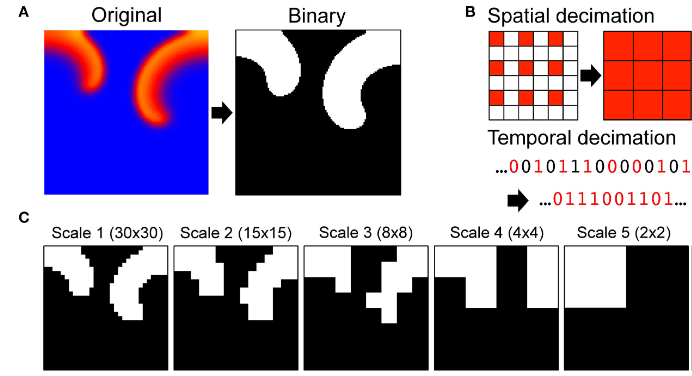
This paper investigates the causal relationship between macroscopic spiral waves (rotors) and the microscopic dynamics of individual cardiomyocytes during cardiac arrhythmias like atrial fibrillation. By applying a renormalization group approach to a numerical model of cardiac excitation, the study evaluates system behavior across a series of spatiotemporal scales using information-theoretic metrics such as effective information and causal emergence. The findings reveal that effective information peaks at a specific macroscopic scale, demonstrating that a rotor's causal power to maintain spiral waves is scale-dependent rather than universal across all levels of description—an insight that helps clarify the highly variable clinical success of targeted rotor ablation therapies.
Links
BibTeX tap to expand
@ARTICLE{AshikagaDehghani_2018,
AUTHOR={Ashikaga, Hiroshi  and Prieto-Castrillo, Francisco  and Kawakatsu, Mari  and Dehghani, Nima },
TITLE={Causal Scale of Rotors in a Cardiac System},
JOURNAL={Frontiers in Physics},
VOLUME={Volume 6 - 2018},
YEAR={2018},
URL={https://www.frontiersin.org/journals/physics/articles/10.3389/fphy.2018.00030},
DOI={10.3389/fphy.2018.00030},
ISSN={2296-424X},
}
Code & Data
The room
Abstract
Rotors of spiral waves are thought to be one of the potential mechanisms that maintain atrial fibrillation (AF). However, disappointing clinical outcomes of rotor mapping and ablation to eliminate AF raise a serious doubt on rotors as a macro-scale mechanism that causes the micro-scale behavior of individual cardiomyocytes to maintain spiral waves. In this study, we aimed to elucidate the causal relationship between rotors and spiral waves in a numerical model of cardiac excitation. To accomplish the aim, we described the system in a series of spatiotemporal scales by generating a renormalization group, and evaluated the causal architecture of the system by quantifying causal emergence. Causal emergence is an information-theoretic metric that quantifies emergence or reduction between micro- and macro-scale behaviors of a system by evaluating effective information at each scale. We found that the cardiac system with rotors has a spatiotemporal scale at which effective information peaks. A positive correlation between the number of rotors and causal emergence was observed only up to the scale of peak causation. We conclude that rotors are not the universal mechanism to maintain spiral waves at all spatiotemporal scales. This finding may account for the conflicting benefit of rotor ablation in clinical studies.
Citing
If you use this code or build on these ideas, please cite the paper using the BibTeX entry above.
Doors · concepts in this room
Related rooms
How Long Is the Coast of a Neuron? Resolution-Dependent Interaction Order and Computational Capacity
Field closure, ice neurons, and when a dendrite is a motif