A Computational Perspective of the Role of the Thalamus in Cognition
Summary
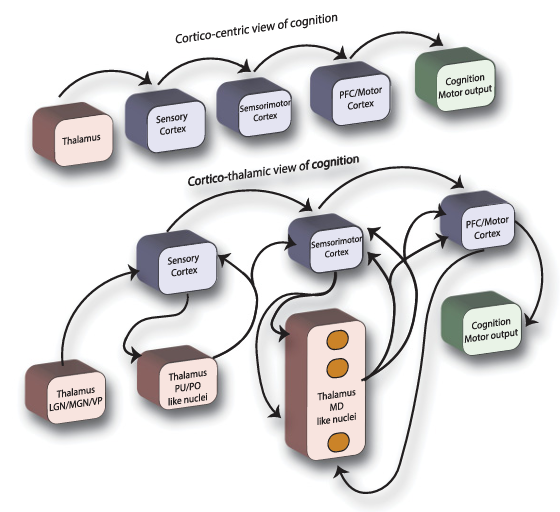
This paper challenges the classical view of the thalamus as a passive relay station that merely forwards sensory inputs to hierarchically organized cortical circuits. Integrating recent experimental and theoretical advances, the perspective highlights that only a subset of thalamic circuit motifs fit the traditional relay description. Instead, the authors argue that higher-order thalamic nuclei—particularly the mediodorsal (MD) nucleus—actively participate in cognitive processing by dynamically selecting and contextually modulating cortical representations. Ultimately, the paper proposes that the thalamus and cortex operate as an integrated system to jointly optimize the trade-off between information throughput and energetic costs in an emergent manner.
Links
BibTeX tap to expand
@article{Dehghani_thalamusComp_2019,
    author = {Dehghani, Nima and Wimmer, Ralf D.},
    title = {A Computational Perspective of the Role of the Thalamus in Cognition},
    journal = {Neural Computation},
    volume = {31},
    number = {7},
    pages = {1380-1418},
    year = {2019},
    month = {07},
    issn = {0899-7667},
    doi = {10.1162/neco_a_01197},
    url = {https://doi.org/10.1162/neco_a_01197},
    eprint = {https://direct.mit.edu/neco/article-pdf/31/7/1380/1053186/neco_a_01197.pdf},
}
Code & Data
The room
Abstract
The thalamus has traditionally been considered as only a relay source of cortical inputs, with hierarchically organized cortical circuits serially transforming thalamic signals to cognitively relevant representations. Given the absence of local excitatory connections within the thalamus, the notion of thalamic relay seemed like a reasonable description over the past several decades. Recent advances in experimental approaches and theory provide a broader perspective on the role of the thalamus in cognitively relevant cortical computations and suggest that only a subset of thalamic circuit motifs fits the relay description. Here, we discuss this perspective and highlight the potential role for the thalamus, and specifically the mediodorsal (MD) nucleus, in the dynamic selection of cortical representations through a combination of intrinsic thalamic computations and output signals that change cortical network functional parameters. We suggest that through the contextual modulation of cortical computation, the thalamus and cortex jointly optimize the information and cost trade-off in an emergent fashion. We emphasize that coordinated experimental and theoretical efforts will provide a path to understanding the role of the thalamus in cognition, along with an understanding to augment cognitive capacity in health and disease.
Citing
If you use this code or build on these ideas, please cite the paper using the BibTeX entry above.
Doors · concepts in this room
Related rooms
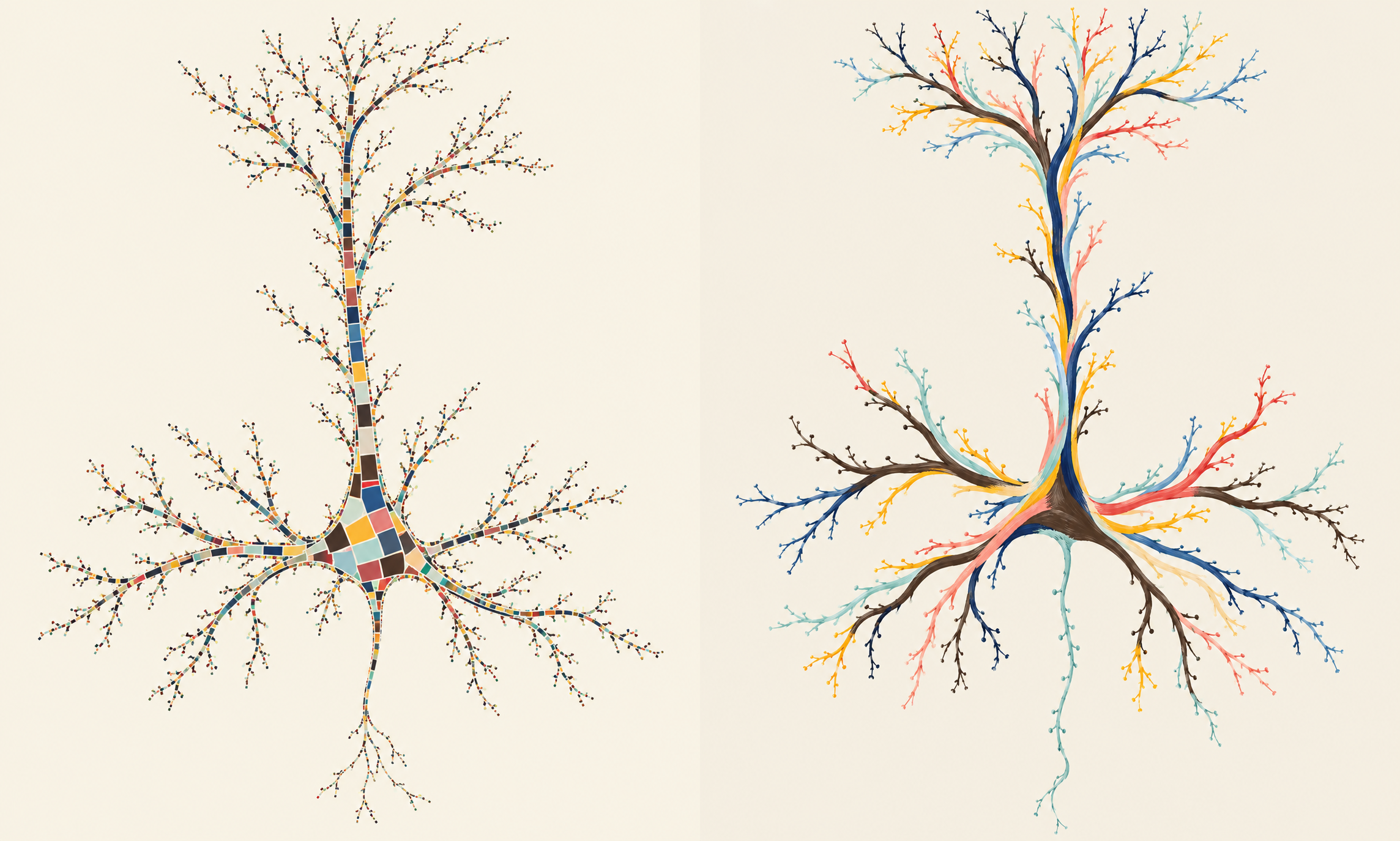
How Long Is the Coast of a Neuron? Resolution-Dependent Interaction Order and Computational Capacity

Field closure, ice neurons, and when a dendrite is a motif