Dynamic Balance of Excitation and Inhibition in Human and Monkey Neocortex
Summary
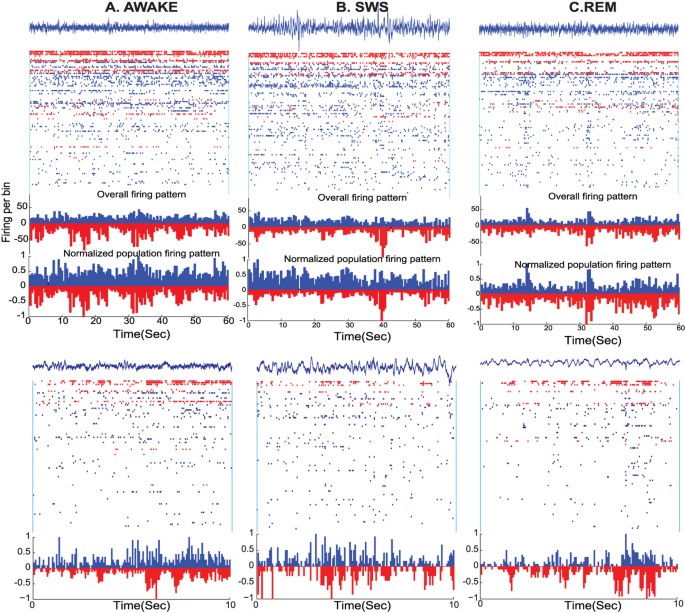
This paper investigates how the tight interplay between excitatory and inhibitory (E/I) neuronal ensembles is maintained across different functional brain states in higher mammals. Using high-density multielectrode array recordings to track population activity in both humans and macaques, the study demonstrates that E/I populations remain closely balanced and co-fluctuate across multiple temporal scales throughout all stages of the wake-sleep cycle (wakefulness, slow-wave sleep, and REM sleep). The strong alignment of these empirical findings with a computational network model suggests that this stable balance is intrinsically generated by recurrent local cortical circuitry rather than relying on external inputs. Finally, the researchers show that this temporal coordination severely breaks down during epileptic seizures, confirming that a disruption of this multiscale E/I balance is a primary feature of pathological brain activity.
Links
BibTeX tap to expand
@Article{Dehghani_balanceEI_2016,
author={Dehghani, Nima
and Peyrache, Adrien
and Telenczuk, Bartosz
and Le Van Quyen, Michel
and Halgren, Eric
and Cash, Sydney S.
and Hatsopoulos, Nicholas G.
and Destexhe, Alain},
title={Dynamic Balance of Excitation and Inhibition in Human and Monkey Neocortex},
journal={Scientific Reports},
year={2016},
month={Mar},
day={16},
volume={6},
number={1},
pages={23176},
issn={2045-2322},
doi={10.1038/srep23176},
url={https://doi.org/10.1038/srep23176}
}
Code & Data
The room
Abstract
Balance of excitation and inhibition is a fundamental feature of in vivo network activity and is important for its computations. However, its presence in the neocortex of higher mammals is not well established. We investigated the dynamics of excitation and inhibition using dense multielectrode recordings in humans and monkeys. We found that in all states of the wake-sleep cycle, excitatory and inhibitory ensembles are well balanced and co-fluctuate with slight instantaneous deviations from perfect balance, mostly in slow-wave sleep. Remarkably, these correlated fluctuations are seen for many different temporal scales. The similarity of these computational features with a network model of self-generated balanced states suggests that such balanced activity is essentially generated by recurrent activity in the local network and is not due to external inputs. Finally, we find that this balance breaks down during seizures, where the temporal correlation of excitatory and inhibitory populations is disrupted. These results show that balanced activity is a feature of normal brain activity and break down of the balance could be an important factor to define pathological states.
Citing
If you use this code or build on these ideas, please cite the paper using the BibTeX entry above.
Doors · concepts in this room
Related rooms
Theoretical Principles of Multiscale Spatiotemporal Control of Neuronal Networks: A Complex Systems Perspective
Spatiotemporal dynamics of neocortical excitation and inhibition during human sleep