Ensemble inhibition and excitation in the human cortex: An Ising-model analysis with uncertainties
Summary
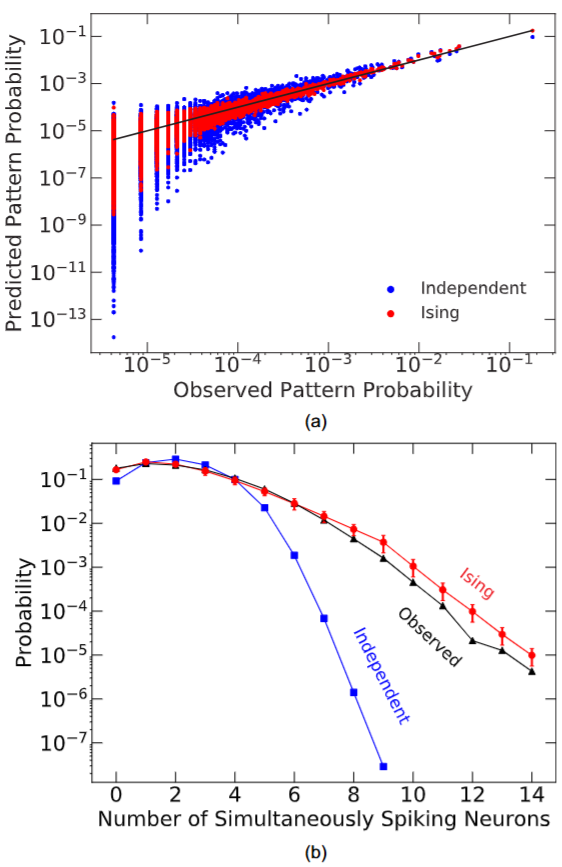
This paper applies the pairwise maximum entropy framework (the Ising model) to analyze the collective dynamics of single-unit spiking data from the human temporal cortex across the wake-sleep cycle. To address previous inconsistencies in the literature regarding how well maximum entropy models fit neural data, we developed an adaptive Markov Chain Monte Carlo (MCMC) method to establish rigorous error estimates and parameter uncertainties. The study demonstrates that the Ising model successfully accounts for 80% to 95% of the neural correlations across all vigilance states, provided that both excitatory and inhibitory populations are modeled simultaneously; crucially, omitting inhibitory interactions leads to a massive overestimation of synchrony within the excitatory network.
Links
BibTeX tap to expand
@article{PhysRevE.99.032408,
title = {Ensemble inhibition and excitation in the human cortex: An Ising-model analysis with uncertainties},
author = {Zanoci, Cristian and Dehghani, Nima and Tegmark, Max},
journal = {Phys. Rev. E},
volume = {99},
issue = {3},
pages = {032408},
numpages = {16},
year = {2019},
month = {Mar},
publisher = {American Physical Society},
doi = {10.1103/PhysRevE.99.032408},
url = {https://link.aps.org/doi/10.1103/PhysRevE.99.032408}
}
Code & Data
The room
Abstract
The pairwise maximum entropy model, also known as the Ising model, has been widely used to analyze the collective activity of neurons. However, controversy persists in the literature about seemingly inconsistent findings, whose significance is unclear due to lack of reliable error estimates. We therefore develop a method for accurately estimating parameter uncertainty based on random walks in parameter space using adaptive Markov-chain Monte Carlo after the convergence of the main optimization algorithm. We apply our method to the activity patterns of excitatory and inhibitory neurons recorded with multielectrode arrays in the human temporal cortex during the wake-sleep cycle. Our analysis shows that the Ising model captures neuronal collective behavior much better than the independent model during wakefulness, light sleep, and deep sleep when both excitatory (E) and inhibitory (I) neurons are modeled; ignoring the inhibitory effects of I neurons dramatically overestimates synchrony among E neurons. Furthermore, information-theoretic measures reveal that the Ising model explains about 80–95% of the correlations, depending on sleep state and neuron type. Thermodynamic measures show signatures of criticality, although we take this with a grain of salt as it may be merely a reflection of long-range neural correlations.
Citing
If you use this code or build on these ideas, please cite the paper using the BibTeX entry above.
Doors · concepts in this room
Related rooms
Theoretical Principles of Multiscale Spatiotemporal Control of Neuronal Networks: A Complex Systems Perspective
Spatiotemporal dynamics of neocortical excitation and inhibition during human sleep